
Μπότες oρειβασίας- τα μυστικά για άνετο περπάτημα!
Οι μπότες αποτελούν ένα από τα σημαντικότερα κομμάτια του εξοπλισμού κάθε πεζοπόρου και ορειβάτη. Πρέπει να εφαρμόζουν σωστά στο πόδι, να προσφέρουν καλό κράτημα και να είναι κατάλληλες για το έδαφος, τις καιρικές συνθήκες και τη δραστηριότητα που έχουμε επιλέξει.
Σήμερα υπάρχει μεγάλη ποικιλία σε πεζοπορικά παπούτσια και ορειβατικές μπότες, με σημαντικές διαφορές ως προς το βάρος, την ακαμψία, τη θερμομόνωση, την αδιαβροχοποίηση και τη διαπνοή τους. Επομένως, πριν από την αγορά πρέπει να γνωρίζουμε πού και πώς σκοπεύουμε να τις χρησιμοποιήσουμε.
Βασικές κατηγορίες
Παπούτσια approach
Τα παπούτσια approach σχεδιάστηκαν κυρίως για την πρόσβαση σε αναρριχητικά πεδία. Συνδυάζουν στοιχεία πεζοπορικού και αναρριχητικού παπουτσιού και συνήθως διαθέτουν σόλα με πολύ καλό κράτημα σε βράχο, σχετικά άκαμπτη κατασκευή και εφαρμογή που επιτρέπει μεγαλύτερη ακρίβεια στα τεχνικά περάσματα. Είναι χρήσιμα για αναρριχητές και ορειβάτες που πρέπει να προσεγγίσουν ένα πεδίο πριν αλλάξουν σε αναρριχητικά παπούτσια ή τεχνικές μπότες. Δεν αντικαθιστούν, όμως, τις κατάλληλες ορειβατικές μπότες σε απαιτητικό χιόνι, παγετό ή πολύ χαμηλές θερμοκρασίες.
Εύκαμπτες μπότες
Είναι κατάλληλες κυρίως για πεζοπορία σε ξέχιονο έδαφος και για διαδρομές χωρίς ιδιαίτερες τεχνικές απαιτήσεις. Συνήθως κατασκευάζονται από συνδυασμό δέρματος και συνθετικών υλικών και ενδέχεται να διαθέτουν αδιάβροχη και διαπνέουσα μεμβράνη, όπως GORE-TEX® ή αντίστοιχη τεχνολογία. Μπορούν να χρησιμοποιηθούν περιστασιακά σε ήπιες χιονισμένες διαδρομές, δεν προσφέρουν όμως την απαιτούμενη σταθερότητα και προστασία για πολύωρη κίνηση σε απαιτητικό χειμερινό πεδίο.
Ημιάκαμπτες μπότες
Αποτελούν μια ευέλικτη ενδιάμεση επιλογή για κίνηση τόσο σε ξέχιονο όσο και σε χιονισμένο πεδίο. Προσφέρουν μεγαλύτερη στήριξη και προστασία από τις εύκαμπτες μπότες και διαθέτουν πιο στιβαρή σόλα. Είναι κατάλληλες για χειμερινή πεζοπορία, ορειβασία σε μέτριες κλίσεις και διαδρομές με εναλλαγές χιονιού και γυμνού εδάφους. Πολλά μοντέλα είναι συμβατά με ημιαυτόματα κραμπόν, αλλά αυτό πρέπει πάντοτε να επιβεβαιώνεται από τον κατασκευαστή.
Άκαμπτες μπότες
Οι άκαμπτες ορειβατικές μπότες προορίζονται για τεχνική χειμερινή ορειβασία, απότομες χιονισμένες ή παγωμένες πλαγιές και παγοαναρρίχηση. Είναι ψηλότερες, πιο ενισχυμένες και συχνά διαθέτουν πρόσθετη θερμομόνωση. Η άκαμπτη σόλα προσφέρει σταθερότητα κατά τη χρήση κραμπόν, κάνει όμως την μπότα πιο βαριά και λιγότερο άνετη στο απλό περπάτημα.
Πλαστικές και διπλές μπότες
Οι παραδοσιακές πλαστικές ορειβατικές μπότες θυμίζουν τις άκαμπτες μπότες του σκι. Προσφέρουν υψηλή αδιαβροχοποίηση και προστασία, αλλά είναι βαριές και άβολες για πολύωρο περπάτημα. Σήμερα έχουν σε μεγάλο βαθμό αντικατασταθεί από σύγχρονες διπλές μπότες, με αφαιρούμενο εσωτερικό μποτάκι, οι οποίες προορίζονται κυρίως για πολύ χαμηλές θερμοκρασίες, μεγάλα υψόμετρα και αποστολές.
Κατηγορίες B0–B3 και συμβατότητα με κραμπόν
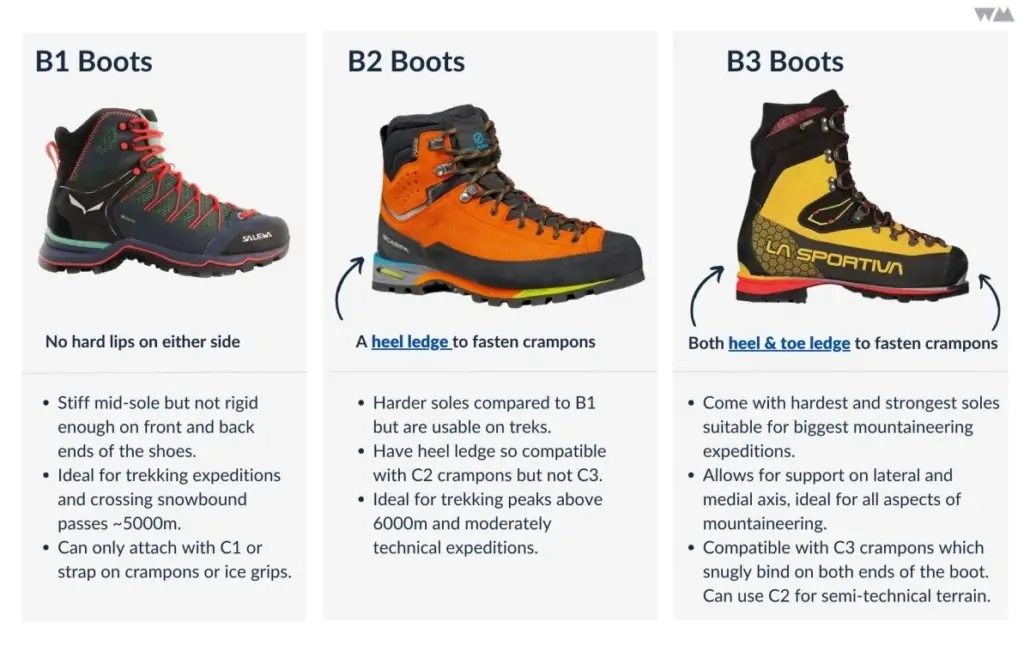
Η συνηθισμένη ταξινόμηση των ορειβατικών υποδημάτων ανάλογα με την ακαμψία και τη συμβατότητά τους με κραμπόν είναι η ακόλουθη:
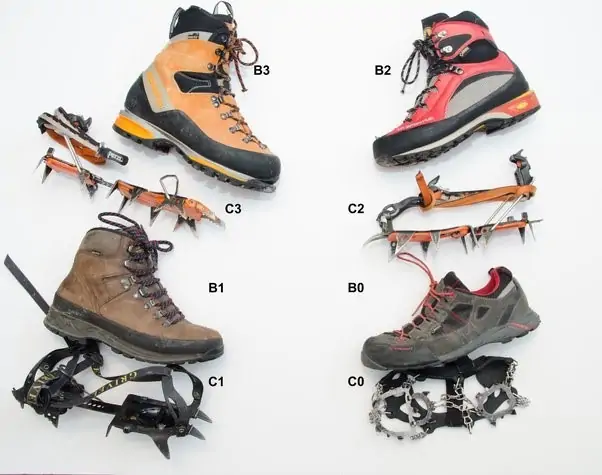
- B0: Εύκαμπτα παπούτσια ή μπότες για πεζοπορία σε ξέχιονο έδαφος. Δεν προορίζονται για κανονικά ορειβατικά κραμπόν. Είναι συμβατές με κραμπόν C0.
- B1: Σχετικά εύκαμπτες μπότες για πεζοπορία και ήπια χειμερινή χρήση. Συνδυάζονται συνήθως με δετά κραμπόν κατηγορίας C1.
- B2: Ημιάκαμπτες μπότες για χειμερινή ορειβασία και κίνηση σε πιο απότομο χιονισμένο πεδίο. Είναι συμβατές συνήθως με κραμπόν C1 και C2.
- B3: Πλήρως άκαμπτες τεχνικές μπότες για απότομες πλαγιές, τεχνική ορειβασία και παγοαναρρίχηση. Είναι συμβατές με κραμπόν C1, C2 και C3.
Η ένδειξη της κατηγορίας αποτελεί έναν χρήσιμο οδηγό, αλλά δεν αρκεί από μόνη της. Πριν συνδυάσουμε οποιαδήποτε μπότα με κραμπόν, πρέπει να ελέγξουμε τις προδιαγραφές των δύο κατασκευαστών και να δοκιμάσουμε προσεκτικά την εφαρμογή τους.
Η σημασία της σόλας
Η σόλα πρέπει να προσφέρει πρόσφυση, σταθερότητα και προστασία ανάλογα με το έδαφος. Σημαντικό ρόλο παίζουν:
- η ποιότητα και η σύνθεση του ελαστικού,
- το βάθος και η διάταξη των τακουνιών,
- η ακαμψία της ενδιάμεσης σόλας,
- η συμπεριφορά σε βρεγμένο βράχο, λάσπη, χιόνι και σαθρό έδαφος.
Η Vibram® είναι ένας από τους γνωστότερους κατασκευαστές σολών, χωρίς αυτό να σημαίνει ότι όλες οι σόλες της έχουν την ίδια απόδοση ή ότι αποτελούν τη μοναδική αξιόπιστη επιλογή.
Υπάρχουν επίσης διαφορετικά ανδρικά και γυναικεία καλαπόδια. Ωστόσο, το σημαντικότερο κριτήριο δεν είναι η ονομασία του μοντέλου, αλλά η πραγματική εφαρμογή στο συγκεκριμένο πόδι.
Πώς δοκιμάζουμε τις μπότες
Η λανθασμένη εφαρμογή μπορεί να προκαλέσει φουσκάλες, πίεση στα δάχτυλα, τραυματισμούς στα νύχια και αστάθεια. Γι’ αυτό η δοκιμή χρειάζεται χρόνο και προσοχή.
Δοκιμή το απόγευμα
Κατά τη διάρκεια της ημέρας τα πόδια πρήζονται ελαφρώς, όπως συμβαίνει και στην πεζοπορία. Είναι προτιμότερο, επομένως, να δοκιμάζουμε τις μπότες το απόγευμα.
Οι σωστές κάλτσες
Φοράμε τις ίδιες κάλτσες που σκοπεύουμε να χρησιμοποιούμε στο βουνό. Οι ειδικές πεζοπορικές κάλτσες από συνθετικές ίνες ή μαλλί merino βοηθούν στη διαχείριση της υγρασίας και μειώνουν τις τριβές. Αποφεύγουμε τις βαμβακερές κάλτσες, επειδή συγκρατούν την υγρασία και στεγνώνουν αργά.
Σωστό δέσιμο
Τοποθετούμε καλά τη φτέρνα πίσω, ισιώνουμε τη γλώσσα και δένουμε τα κορδόνια σταθερά, χωρίς να δημιουργούμε πίεση ή να περιορίζουμε την κυκλοφορία του αίματος.
Χώρος για τα δάχτυλα
Μπροστά από το μακρύτερο δάχτυλο πρέπει να υπάρχει περίπου ένα εκατοστό ή ένα πλάτος αντίχειρα. Δεν επιλέγουμε όμως μηχανικά μισό ή ένα νούμερο μεγαλύτερο, καθώς η σωστή εφαρμογή εξαρτάται και από το πλάτος, τον όγκο και το σχήμα του ποδιού.
Έλεγχος εφαρμογής
Με τις μπότες δεμένες, περπατάμε αρκετά μέσα στο κατάστημα και, εφόσον υπάρχει, χρησιμοποιούμε την ειδική κεκλιμένη επιφάνεια δοκιμής για να ελέγξουμε:
- αν η φτέρνα παραμένει σταθερή χωρίς έντονη ανύψωση,
- αν τα δάχτυλα κινούνται άνετα,
- αν τα δάχτυλα χτυπούν μπροστά στην κατάβαση,
- αν υπάρχει πίεση, μούδιασμα ή τριβή σε οποιοδήποτε σημείο,
- αν το πόδι γλιστράει μέσα στην μπότα.
Προσαρμογή της καινούργιας μπότας
Ορισμένες δερμάτινες ή τεχνικές μπότες χρειάζονται σταδιακή χρήση μέχρι να μαλακώσουν. Ξεκινάμε με μικρές διαδρομές πριν τις χρησιμοποιήσουμε σε μεγάλη πορεία. Η διαδικασία αυτή δεν μπορεί να διορθώσει μια λανθασμένη εφαρμογή. Αν αισθανόμαστε έντονη πίεση, εξογκώματα ή υπερβολικό κενό από την πρώτη δοκιμή, πιθανότατα χρειαζόμαστε διαφορετικό μοντέλο ή καλαπόδι.
Σωστό δέσιμο στην πορεία
Το σωστό δέσιμο κρατά σταθερό το πόδι, περιορίζει τις τριβές και βοηθά στον έλεγχο της κίνησης. Δεν μπορεί, ωστόσο, να υποκαταστήσει τη σωστή εφαρμογή της μπότας (δες περισσότερα για το δέσιμο των κορδονιών).
Στην ανάβαση
Η φτέρνα πρέπει να παραμένει σταθερή, ενώ το επάνω μέρος της μπότας μπορεί να είναι ελαφρώς πιο χαλαρό ώστε να επιτρέπει την κίνηση της ποδοκνημικής και να μην πιέζει την κνήμη.
Στην κατάβαση
Το πόδι έχει την τάση να μετακινείται προς τα εμπρός. Σταθεροποιούμε καλά τη φτέρνα και δένουμε τα κορδόνια έτσι ώστε το πόδι να μη γλιστράει μέσα στην μπότα, χωρίς όμως να πιέζονται τα δάχτυλα. Κατά τη διάρκεια μιας μεγάλης πορείας μπορεί να χρειαστεί να προσαρμόσουμε το δέσιμο περισσότερες από μία φορές.
Καθαρισμός και συντήρηση
Η σωστή φροντίδα παρατείνει τη ζωή της μπότας και διατηρεί την απόδοσή της. Ακολουθούμε πάντοτε πρώτα τις οδηγίες του κατασκευαστή.
Προετοιμασία
Αφαιρούμε τους πάτους και τους αφήνουμε να στεγνώσουν χωριστά. Αν πρόκειται να γίνει σχολαστικός καθαρισμός ή περιποίηση του δέρματος, αφαιρούμε και τα κορδόνια.
Καθαρισμός
Απομακρύνουμε τη λάσπη με μαλακή βούρτσα και καθαρό νερό. Καθαρίζουμε επίσης τη σόλα και αφαιρούμε μικρές πέτρες από τα τακούνια της. Δεν χρησιμοποιούμε ισχυρά απορρυπαντικά, κοινό σαπούνι ή προϊόντα που δεν είναι κατάλληλα για δέρμα και αδιάβροχες μεμβράνες.
Εσωτερικό
Αν χρειάζεται, καθαρίζουμε προσεκτικά το εσωτερικό με χλιαρό νερό ή με προϊόν εγκεκριμένο από τον κατασκευαστή. Δεν βάζουμε ποτέ τις μπότες στο πλυντήριο.
Στέγνωμα
Αφήνουμε τις μπότες να στεγνώσουν φυσικά, σε σκιερό και καλά αεριζόμενο χώρο. Δεν τις τοποθετούμε στον ήλιο, δίπλα σε καλοριφέρ, σόμπα, φωτιά ή άλλη ισχυρή πηγή θερμότητας, επειδή μπορεί να καταστραφούν το δέρμα, οι κόλλες και οι μεμβράνες. Για ταχύτερο στέγνωμα μπορούμε να γεμίσουμε χαλαρά το εσωτερικό με εφημερίδα και να την αλλάζουμε όταν υγραίνεται.
Αδιαβροχοποίηση
Όταν το εξωτερικό υλικό πάψει να απωθεί το νερό, εφαρμόζουμε κατάλληλο προϊόν αδιαβροχοποίησης, σύμφωνα με τις οδηγίες του κατασκευαστή. Πολλά προϊόντα εφαρμόζονται καλύτερα όταν η επιφάνεια είναι καθαρή και ελαφρώς νωπή.
Περιποίηση δέρματος
Οι δερμάτινες μπότες χρειάζονται κατά διαστήματα ειδικό κερί ή προϊόν περιποίησης. Η υπερβολική χρήση μπορεί να επηρεάσει τη διαπνοή ή την υφή του δέρματος, γι’ αυτό ακολουθούμε τη συνιστώμενη ποσότητα. Είναι φυσιολογικό το δέρμα να σκουρύνει μετά την εφαρμογή.
Η σωστή μπότα είναι αυτή που ταιριάζει στη διαδρομή και στο πόδι μας
Δεν υπάρχει μία μπότα κατάλληλη για όλες τις δραστηριότητες. Άλλες απαιτήσεις έχει μια καλοκαιρινή πεζοπορία σε μονοπάτι και άλλες μια χειμερινή ανάβαση με κραμπόν.
Επιλέγουμε πρώτα με βάση τη χρήση και την ασφάλεια και στη συνέχεια με βάση την εφαρμογή, το βάρος και την άνεση. Ακόμη και η ακριβότερη ή τεχνικά πιο προηγμένη μπότα δεν είναι σωστή επιλογή, αν δεν εφαρμόζει καλά στο δικό μας πόδι.