
The Proclamation of Tyrol and its Significance
The Tyrol Declaration is one of the most important international documents of ethics and principles for mountaineering and mountain sports. It was issued in 2002 in Innsbruck (Tyrol, Austria), during the conference of the UIAA (International Climbing and Mountaineering Federation), and serves as a "common framework" for what is considered responsible mountaineering behavior.
1) What it says in simple terms
The Declaration is not a law. It is a code of ethics.
It sets principles for:
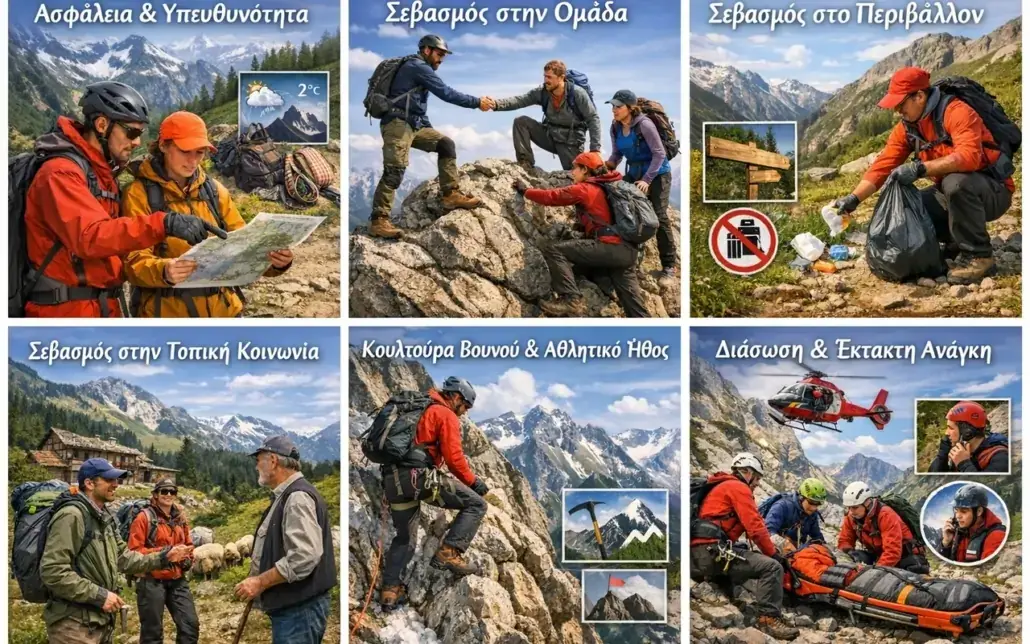
A) Safety & responsibility
- Preparation, knowledge, autonomy
- Realistic risk assessment
- Safety is not just an "individual matter" — it affects others (group, rescuers, etc.)
B) Respect for the environment
- Minimal footprint (Leave No Trace logic)
- Protection of trails, flora/fauna, rock
- Mountaineering without destruction and "overexploitation" of areas
C) Respect for local communities
- Mountaineering activity with respect for:
- residents
- property
- culture
- local economy
D) Equality – access – human dignity
- Promotes that mountaineering should be open, without discrimination
- Emphasizes behavior without exclusion (gender, age, origin, etc.)
E) Mountaineering culture & "fair means"
- Recognizes that there is an ethical dimension to the way you climb:
- how "intrusive" the equipment is
- how much you "pressure" the environment
- what respect for difficulty and experience means
2) Why it is important internationally
It is essentially the most recognized text that says:
"Mountaineering is freedom, but this freedom is accompanied by responsibility."
And it does so in a way that:
- covers mountaineering, climbing, alpinism, ski mountaineering
- unites different "schools" and cultures
3) How it affects the mountaineering community in Greece
In Greece, the Declaration affects mainly indirectly (not institutionally), but has substantial impact at 3 levels:
A) As an ethical framework for clubs & training
Mountaineering clubs and educational structures (mountain schools, climbing schools, etc.) now have an "international reference" for:
- behavior on the mountain
- group safety
- environmental responsibility
- respect for other user groups (hikers, hunters, herders)
B) In risk management and the culture of "it's not shameful to turn back"
It strongly influences the modern understanding that:
- the decision to turn back is a sign of maturity
- "heroicizing" risk is wrong
- rescue is not a "given" service
C) In conflicts around bolting, climbing areas, trails
Especially in climbing, the Declaration is used as an "ethical tool" in discussions such as:
- Where is bolting permitted;
- How much are we allowed to "equip" a route;
- How do we protect an area from excessive tourist pressure;
It does not give "final answers", but it does give principles.
4) The most practical conclusion for Greece
If we sum it up:
The Tyrol Declaration in Greece functions as:
- international code of ethics
- "common language" between clubs, guides, educators, climbers
- basis for a more mature culture of safety and environmental protection